When Does Force Become Excessive? Lessons in Legal Authority and Professional Conduct for Ontario Private Investigators

Private investigators in Ontario work in situations that require discretion, professionalism, sound judgment, and a clear understanding of their legal responsibilities.
Whether conducting surveillance, investigating workplace incidents, gathering evidence, or interviewing individuals, private investigators may encounter situations involving confrontation, resistance, or heightened emotions.
Although private investigators typically do not perform the same duties as security guards, both professions share an important responsibility: understanding the limits of their authority and ensuring their actions remain lawful.
At Ontario Private Investigator License, we recognize that a strong understanding of legal responsibilities, communication, and professional conduct is essential for anyone pursuing a career in private investigation.
An August 2026 incident at a Winnipeg nightclub, involving three security guards charged following a physical confrontation with a patron, provides an important reminder of what can happen when the use of force becomes the subject of a criminal investigation.
While the incident involved security personnel rather than private investigators, the lessons surrounding legal authority, individual accountability, and conflict management are relevant to professionals across the private security and investigation industries.
The Incident: Three Security Guards Charged
At approximately 1 a.m. on August 3, 2026, Winnipeg police responded to a disturbance at a nightclub in the 400 block of Main Street.
According to police, a 28-year-old patron had been involved in an altercation with security personnel and required hospital treatment for his injuries.
The patron was later identified as Teddy Allen, a professional basketball player with the Winnipeg Sea Bears.
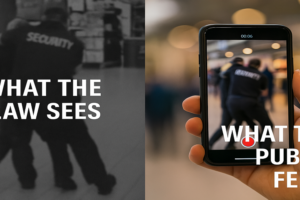
According to news reports, video footage taken inside the nightclub shows Allen being forcefully removed by at least three security guards.
On August 12, three security guards were arrested and charged with assault causing bodily harm.
The Winnipeg Police Service subsequently released information about the investigation and resulting charges.
It is important to emphasize that criminal charges are allegations, not findings of guilt. The available reporting does not provide a complete account of the events leading up to, during, or following the confrontation.
Nevertheless, the incident raises important questions about the limits of professional authority, the use of force, and individual accountability.
For Ontario private investigators, it also reinforces the importance of understanding what actions are legally permitted when an investigation or professional interaction becomes confrontational.
Understanding the Legal Authority of Private Investigators in Ontario
One of the most important distinctions between private investigators and security guards is the nature of their professional responsibilities.
Security guards are generally employed to protect people, property, and premises.
Private investigators, on the other hand, are primarily responsible for gathering information and evidence on behalf of clients.
Their work may involve surveillance, background investigations, locating individuals, interviewing witnesses, or investigating suspected misconduct.
While both professions are regulated in Ontario, their duties and legal authorities are not interchangeable.
Ontario’s Private Security and Investigative Services Act
Private investigators in Ontario are regulated under the Private Security and Investigative Services Act, 2005.
This legislation establishes licensing requirements and standards of conduct for individuals and businesses providing private investigative services.
It is important to understand that holding a private investigator licence does not provide the same powers as a police officer.
Private investigators do not receive special authority to arrest individuals, conduct searches, or use force simply because they are licensed.
Instead, they must operate within the same legal framework that applies to other members of the public, while also meeting the professional obligations associated with their licence.
For example, a private investigator conducting surveillance may encounter an individual who becomes suspicious or confrontational.
The investigator must understand how to respond appropriately without exceeding their legal authority or compromising the investigation.
Professional licensing establishes responsibilities and standards. It does not grant unlimited enforcement powers.
Understanding Trespassing Laws
Ontario’s Trespass to Property Act establishes rules governing unauthorized access to private property.
Property owners and authorized representatives may restrict access to certain premises and require individuals to leave.
In specific circumstances, the legislation also permits an occupier or a person authorized by the occupier to arrest someone for trespassing.
However, a private investigator does not automatically receive this authority simply by holding a private investigator licence.
For example, an investigator conducting surveillance near a commercial property may be asked to leave by the property owner or an authorized representative.
The investigator must respect applicable property laws and cannot assume that the purpose of an investigation provides an exemption from trespassing restrictions.
Similarly, a private investigator who witnesses someone trespassing does not automatically have the authority to detain or remove that individual.
Any authority to act must come from the applicable law and the circumstances, not merely from the investigator’s professional title.
Understanding these distinctions is essential for conducting investigations legally and professionally.
Criminal Code Section 35: Defence of Property
Another important consideration is Section 35 of the Criminal Code of Canada, which addresses the defence of property.
Generally speaking, this section provides a legal defence for individuals in peaceable possession of property, or those acting under their authority, who take reasonable actions to protect that property in qualifying circumstances.
This may include situations involving unauthorized entry, interference with property, or refusal to leave.
However, the law requires that any actions taken be reasonable in the circumstances.
For private investigators, this distinction is important.
An investigator may be hired to gather evidence relating to theft, fraud, or other suspected wrongdoing, but that assignment does not automatically authorize them to physically intervene or remove individuals from a property.
Investigating an incident and enforcing property rights are different responsibilities.
If an investigator is working alongside security personnel or property management, it is important that everyone understands their respective roles.
Having a legitimate reason to investigate someone’s actions does not automatically create the legal authority to physically intervene.
The Winnipeg nightclub incident demonstrates why professionals must distinguish between having authority to act and ensuring that their actions remain legally justified.
Reasonable Force: Understanding the Limits
The use of force is a serious legal consideration for anyone working in the private security and investigation industries.
Although private investigators generally do not perform physical security duties, they may encounter situations involving threats, aggression, or attempts to interfere with their work.
In these circumstances, understanding the legal limits of self-defence and other applicable Criminal Code provisions is essential.
Section 34 of the Criminal Code addresses self-defence.
It provides a legal defence in qualifying circumstances where an individual reasonably believes force is being used or threatened against them or another person, acts for a defensive purpose, and responds reasonably in the circumstances.
However, the existence of a self-defence provision does not mean that every physical response is legally justified.
The circumstances surrounding an incident, the seriousness of the threat, and the nature of the response all matter.
The National Use of Force Framework
The National Use of Force Framework provides a conceptual approach to assessing situations and selecting appropriate responses.
Although developed for policing, its principles offer useful lessons about assessing risk and responding to changing circumstances.
The framework is not legislation and does not independently authorize the use of force.
Instead, it emphasizes the importance of considering factors such as:
- The individual’s behaviour and level of resistance.
- The surrounding environment.
- The seriousness and immediacy of any threat.
- Available alternatives.
- Changes in the situation as events unfold.
For private investigators, the most important lesson is that situations must be continually assessed.
An encounter that begins as a routine conversation may become confrontational. Similarly, an individual who initially appears aggressive may become cooperative when approached calmly.
Professionals must recognize these changes and adjust their responses accordingly.
Any use of force must have a lawful basis and remain reasonable in the circumstances.
Communication and De-escalation in Private Investigations
Effective communication is one of the most valuable skills a private investigator can develop.
Although much of an investigator’s work involves observation and information gathering, direct interactions with individuals may be necessary.
These interactions can involve witnesses, employees, clients, or individuals who are the subject of an investigation.
In some circumstances, people may become defensive, argumentative, or unwilling to cooperate.
The way an investigator responds can influence whether the situation remains manageable or escalates.
Maintaining a calm tone, providing clear explanations, and avoiding unnecessary confrontation can help protect both the investigator and the integrity of the investigation.
Applying a Structured Communication Approach
One useful strategy is to adapt the principles of the Refusal Approach to situations where an individual is unwilling to cooperate.
- Ask Again
Clearly and respectfully repeat the request.
“Would you be willing to answer a few questions about what happened?”
- Reason
Explain the purpose of the request without making misleading claims about your authority.
“I’m gathering information about an incident and would appreciate your perspective.”
- Benefits
Explain why cooperation may be helpful.
“Your account could help provide a more complete understanding of what occurred.”
- Options
Respectfully explain the individual’s choices.
“If you’d prefer not to speak with me, I understand. You can also contact me later if you change your mind.”
- Confirmation
Confirm that the individual understands the request and has an opportunity to respond.
- Action
Proceed appropriately based on the individual’s decision.
If they agree to cooperate, continue the conversation professionally.
If they decline, respect their decision and consider other lawful investigative methods.
This approach emphasizes professionalism, respect, and the importance of obtaining information without unnecessary pressure.
For private investigators, knowing when to disengage can be just as important as knowing how to ask the right questions.
Teamwork and Individual Accountability
The Winnipeg nightclub incident involved multiple security guards participating in the removal of Teddy Allen.
Although private investigators typically work in different circumstances, the importance of teamwork and individual accountability applies to both professions.
Private investigations may involve several investigators, security personnel, legal representatives, or other professionals working toward a common objective.
Clear communication and defined responsibilities help ensure that everyone understands their role.
For example, an investigation into suspected workplace theft may involve a private investigator gathering evidence while security personnel remain responsible for access control and other security duties.
Confusion about these responsibilities can create unnecessary risks.
It is equally important to recognize that each professional remains responsible for their own conduct, even when acting as part of a team.
Following instructions from a client, supervisor, or colleague does not automatically make an unlawful action acceptable.
In the Winnipeg incident, three security guards were charged in connection with the confrontation. The legal process will determine the outcome of those allegations.
For private investigators, the broader lesson is that professionalism and individual accountability must remain priorities throughout every assignment.
Key Lessons for Ontario Private Investigators
The Winnipeg incident highlights several important principles that apply to private investigators working throughout Ontario.
1. Understand the Limits of Your Authority
Private investigators must understand the legal framework governing their work.
Ontario’s Private Security and Investigative Services Act establishes professional requirements, but it does not grant investigators the same enforcement powers as police officers.
Knowing what actions are legally permitted is essential.
2. Prioritize Communication and De-escalation
Confrontational situations can often be managed through calm communication and professional judgment.
Investigators should avoid unnecessary escalation and recognize when disengagement is the safest and most appropriate option.
3. Respect Professional Boundaries
Private investigators are primarily responsible for gathering information and evidence.
They should not assume that an investigative assignment authorizes them to detain individuals, enforce property rules, or physically intervene.
4. Maintain Individual Accountability
Every investigator is responsible for their own actions.
Working with a team or following a client’s instructions does not remove the obligation to comply with the law and professional standards.
5. Recognize the Consequences of Unlawful Conduct
Exceeding legal authority or engaging in inappropriate conduct can have serious consequences, including:
- Criminal charges.
- Civil liability.
- Loss of employment.
- Licensing consequences.
- Compromised investigations.
- Damage to professional reputation.
Understanding these risks is an important part of working responsibly in Ontario’s private investigation industry.
Why Proper Private Investigator Training Matters in Ontario
Private investigators working in Ontario encounter a wide variety of situations that require professionalism, discretion, sound judgment, and an understanding of legal responsibilities.
From conducting surveillance and gathering evidence to interviewing witnesses and investigating suspected misconduct, private investigators must be prepared to make informed decisions.
Completing private investigator training in Ontario provides an important foundation in areas such as legal authorities, investigative procedures, communication, ethics, and professional conduct.
In Ontario, individuals pursuing a private investigator licence must complete the required basic training, pass the provincial licensing test, and meet the applicable licensing requirements.
However, professional development should not stop once an investigator receives their licence.
Ongoing learning helps investigators strengthen their decision-making skills and better prepare for challenging situations.
The Winnipeg nightclub incident demonstrates how quickly a confrontation can lead to serious legal consequences.
Although the circumstances involved security guards rather than private investigators, the underlying lessons about legal authority, reasonable responses, and professional accountability apply across both industries.
Effective investigative work is not about exercising authority beyond what the law permits. It is about gathering information professionally, respecting legal boundaries, and making responsible decisions in challenging situations.
Whether you’re beginning your career or looking to strengthen your professional knowledge, developing a solid understanding of legal responsibilities, communication, and investigative ethics is an important step toward becoming a capable private investigator.
Interested in starting a career as a private investigator in Ontario?
Visit OntarioPrivateInvestigatorLicense.com to explore private investigator training opportunities, learn more about licensing requirements, and take the first step toward entering this rewarding profession.
References
Canadian Association of Chiefs of Police. (2000). A national use of force framework.
https://www.cacp.ca/_Library/resources/National_Use_of_Force_Framework.pdf
Criminal Code, R.S.C. 1985, c. C-46, ss. 26, 34, 35.
https://laws-lois.justice.gc.ca/eng/acts/C-46/
Government of Ontario. (2005). Private Security and Investigative Services Act, 2005, S.O. 2005, c. 34.
https://www.ontario.ca/laws/statute/05p34
Government of Ontario. (1990). Trespass to Property Act, R.S.O. 1990, c. T.21.
https://www.ontario.ca/laws/statute/90t21
Government of Manitoba. (1987). The Trespass Act, C.C.S.M. c. T156.
https://web2.gov.mb.ca/laws/statutes/ccsm/t156.php
Patterson, K. (2026, August 13). 3 security guards facing assault charges after Winnipeg Sea Bears’ Teddy Allen injured. CityNews Winnipeg.
https://winnipeg.citynews.ca/2026/08/13/teddy-allen-injury-security-guards-assault/
Winnipeg Police Service. (2026, August 13). Assault investigation at licensed premise results in charges: C26-191112. City of Winnipeg.
https://www.winnipeg.ca/police/community/news-releases/2026-08-13-assault-investigation-licensed-premise-results-charges-c26-191112